Woman found guilty in 2024 Dollar General blaze
Published 5:00 am Saturday, October 31, 2026

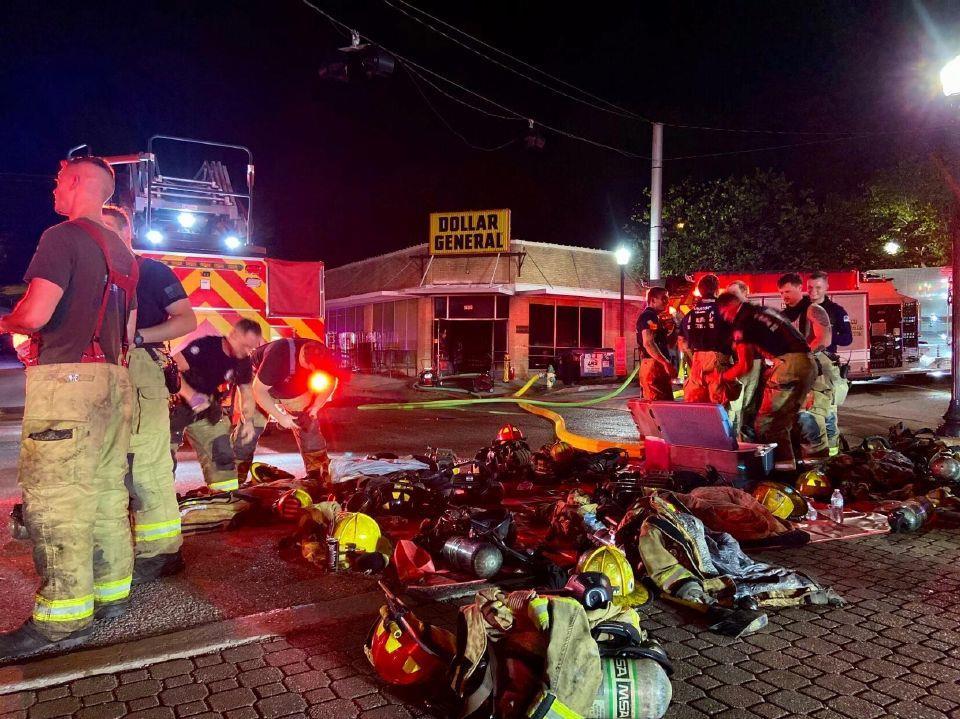
On September 29, 2024, the Dollar General located on Harrison Square caught fire, destroying the interior and the roof. Two employees were the only ones inside the building when it happened. Two years later, a jury found one of those employees guilty of arson and aggravated assault. Stephanie Marie Cash was sentenced to 10 years in prison and a $500 fine.
Her trial took place over three days at the J. Smith Henley building. The prosecution was led by Deputy Prosecutors Brad Brown and Patricia Virnig. Attorney James Shaw represented Cash. Judge John Putman presided over the proceedings.
Cash, now age 27, stands around 4 feet tall. Her stature was mentioned at various points throughout the trial and is therefore noted here.
After jury selection, the prosecution began opening statements. Brown explained to the jury that no one else could have started the fire and cautioned the jury against appearance bias. He asked them to consider what a criminal looks like, reminding them that their appearance spans the gamut.
In return, Shaw reminded the jury that Cash was innocent until the State proved her guilty beyond a reasonable doubt. He cautioned that the store videos from the night of the fire the prosecution would present were a framework around which the State had constructed a convenient story. He suggested that if the State could indeed prove the fire was arson, it certainly couldn’t prove that his client had caused it.
Among the witnesses called by the prosecution was Michelle Honing, the current manager of Dollar General, as well as at the time of the fire. She said that she’d known Cash since childhood and found her to be a good employee. Honing hired Cash, she said, because she had an Associate’s Degree in Business and seemed to show promise.
Honing testified that the only disciplinary issues she’d had with Cash resulted from occasional customer complaints. Upon reviewing the incidents, Honing said that Cash’s negative interactions with customers were always the result of them commenting on her height or youthful appearance. Honing seemed to sympathize with Cash, noting that those comments could be upsetting. She felt the complaints didn’t warrant “write-ups” and maintained that Cash was a good performer at work.
Honing verified that Cash was an occasional smoker when asked by the prosecution. Additionally, Honing was able to provide an encyclopedic recall of the store’s interior layout prior to the fire, with merchandise described nearly shelf by shelf.
In cross-examination, Shaw tried to open the door for the possibility that an angry former employee or customer may have had reason to start the fire. Honing said she couldn’t think of anyone like that, noting that many of the employees who left her store did so due to promotion. She said that, at the time, she didn’t think Cash had done it either.
When the defense asked about the store’s maintenance status, Honing said that despite the many tickets she’d submitted, none were related to issues that could have started a fire. The defense asked whether Cash remained employed after the fire, and Honing confirmed that, yes, Cash worked for months afterward.
The prosecution circled back to Honing and established that although she hired Cash, they very rarely worked together. Brown asked if Honing had heard any rumors about Cash after the fire, to which she said people reported witnessing her talking to herself.
The next significant witness called by the prosecution was Andrew Wilson. Wilson was the second employee and acting supervisor on the night of the fire. Wilson described having received complaints about Cash not being at the register on occasion.
Policy, according to Honing and Wilson, dictated that Cash, as cashier, should have remained at the front of the store in order to check out customers. As manager, Wilson was responsible for the back half of the store. Her location throughout the evening leading up to the fire would come under close scrutiny as the next witness was called.
On the second day of the trial, Lt. John Morgan of the Harrison Fire Department was called to the stand by the prosecution. He verified that he was a fire marshal and fire investigator. During the course of investigating the fire, he determined the point of origin, though not exactly what started it. That did not stop him from identifying who he thought started it, though.
Morgan described three ways, learned through his training, that fires started: natural, accidental and intentional. Natural fires may start from incidents such as lightning, though none was reported that night. Accidental fires could include electrical fires or a burn pile that gets out of control. In the absence of evidence for those two reasons, fires must be intentionally set.
As Morgan investigated the fire, he found no evidence of a natural or accidental fire. He found no evidence that the aisle contained items that could have spontaneously combusted and he determined the aisle had no electricity running to it. He determined the fire, which started on the second shelf, was likely started by a person.
During his search, he found the store’s DVR with security footage intact. As he examined the footage, which did not show directly into the aisle where the fire started, he determined that Cash was the only one who could have started it.
This footage was painstakingly examined during the trial. The prosecution, with Morgan’s help, showed the jury Cash’s movements throughout the store over the last hour it was open. While the footage didn’t directly show the point of origin, it did show either end of the aisle. From that, Morgan determined that Cash was the only person to enter that aisle between 8:23 p.m. and 9:15 p.m., when the fire became visible on camera.
Cash spent about 10 minutes in that aisle over four trips. Additionally, it was an aisle that both Honing and Wilson agreed was not within her area of responsibility.
In the footage, the prosecution pointed out times when she appeared to be acting erratically before the fire was captured on camera.
Wilson is captured on camera during the time the fire is suspected to have started, counting money in a back office. When he came to the front of the store to leave, he noticed a strange smell and followed it to the fire, he testified. He attempted to put it out with a fire extinguisher to no avail. During this attempt, he testified that he sent Cash outside to call 911. Realizing he couldn’t put it out, he evacuated as well. Shortly thereafter, flashover occurred. This was described by Morgan as when the smoke itself catches fire, creating a rapid conflagration that can reach 1,100 degrees Fahrenheit. Morgan testified that it would have been hot enough to kill someone.
During cross-examination, Shaw asked about 6-volt batteries that Morgan found on a shelf near the point of origin. Morgan felt they didn’t show signs of having caused the fire, though Shaw suggested that they could have.
Shaw also went to some lengths in suggesting that Cash’s “erratic” behavior was consistent with normal activities, such as talking on the phone and needing to use the restroom. He also pointed out that just because Morgan hadn’t identified that a device, perhaps time-delayed, had been used didn’t mean that one wasn’t.
The defense attempted to paint Morgan as inexperienced in fire investigations, having worked on fewer than four arson cases at the time of the DG fire. He also hammered Morgan after the investigator answered that he hadn’t examined footage from any other shift Cash had worked before establishing what unusual behavior might look like for her.
On the third day of the trial, both sides gave closing statements. The prosecution reiterated the three ways in which fire starts, noting the investigation had eliminated two of the three. Brown also dismissed the suggestion that an earlier planted device had been used. If a device was used, why have it go off while people were still in the store, he asked. Any alternative to Cash starting the fire, he suggested, was not reasonable.
Shaw presented several alternative explanations for her behavior that night, seeking to show that reasonable doubt existed. He told the jury there was definitely a fire, that it might have been intentional, but that there wasn’t evidence that it was Cash.
The jury deliberated throughout the morning and into the afternoon. Ultimately, they found her guilty on both counts. After hearing from both sides again regarding sentencing, they decided to give her the lightest sentence allowable. Facing life in prison and $10,000 in fines, she received the minimum of 10 years and a $500 fine. Prior to their sentencing deliberations, they were informed that with a 10-year sentence, Cash could be out on parole in as little as 2.5 years.
Throughout the trial, Cash presented a calm demeanor. This didn’t appear to change after hearing the guilty verdict or sentencing. As she did not testify in her defense, what little she did say stood out. After being found guilty, she turned to face a companion in the audience and said, “Please take care of my cats.”